

Standard operating procedure
Truck Mounted Crane (HIAB)
Read this procedure as text
Truck Mounted Crane (HIAB): text version
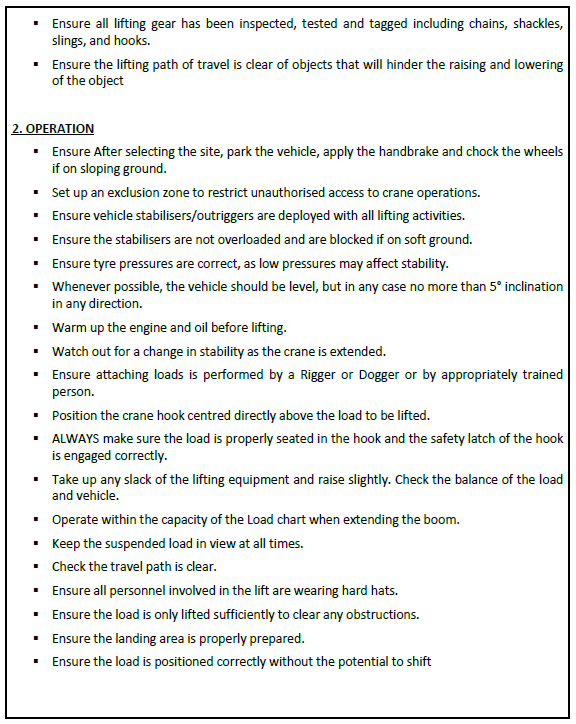
No person shall commence work involving the operation of any tools, plant or equipment unless they have been trained, deemed competent and authorised. All operators shall read, understand and follow this safe work instruction
- Description of work
- Operating a Truck Mounted Crane (HIAB)
- Potential hazards
- hydraulics, crush points, tools or material falling, moving parts, plant tipping, entrapment, electrocution, high pressure fluid, manual handling
- PPE required
- Gloves, Head Protection, Appropriate Footwear
1. PRE-OPERATION
- Ensure operator has required training and current VOC to use the vehicle mounted crane and/or attach lifting gear to the load.
- Ensure the crane testing, maintenance certificates and records are current
- Ensure crane controls, emergency stops, path of travel, ropes and hooks are in serviceable condition.
- Ensure the ground is sturdy enough to accommodate the vehicle stabilisers/outriggers.
- Conduct Pre-operational checklist for Crane and record in Log Book. Isolate and Tag out of service if issue is found.
- Ensure crane has a nominated SWL/WLL and correct Load Plates are clearly visible.
- Ensure all lifting gear has been inspected, tested and tagged including chains, shackles, slings, and hooks.
- Ensure the lifting path of travel is clear of objects that will hinder the raising and lowering of the object
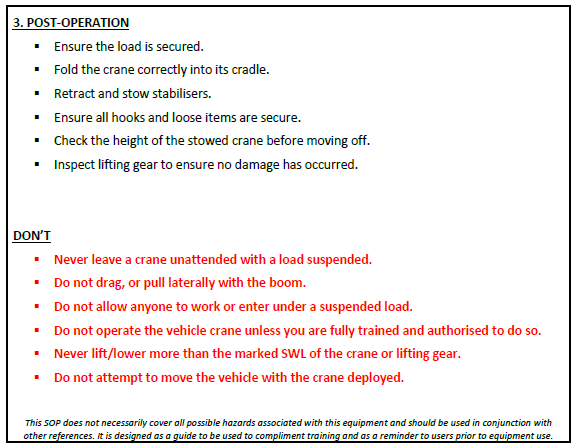
2. OPERATION
- Ensure After selecting the site, park the vehicle, apply the handbrake and chock the wheels if on sloping ground.
- Set up an exclusion zone to restrict unauthorised access to crane operations.
- Ensure vehicle stabilisers/outriggers are deployed with all lifting activities.
- Ensure the stabilisers are not overloaded and are blocked if on soft ground.
- Ensure tyre pressures are correct, as low pressures may affect stability.
- Whenever possible, the vehicle should be level, but in any case no more than 5° inclination in any direction.
- Warm up the engine and oil before lifting.
- Watch out for a change in stability as the crane is extended.
- Ensure attaching loads is performed by a Rigger or Dogger or by appropriately trained person.
- Position the crane hook centred directly above the load to be lifted.
- ALWAYS make sure the load is properly seated in the hook and the safety latch of the hook is engaged correctly.
- Take up any slack of the lifting equipment and raise slightly. Check the balance of the load and vehicle.
- Operate within the capacity of the Load chart when extending the boom.
- Keep the suspended load in view at all times.
- Check the travel path is clear.
- Ensure all personnel involved in the lift are wearing hard hats.
- Ensure the load is only lifted sufficiently to clear any obstructions.
- Ensure the landing area is properly prepared.
- Ensure the load is positioned correctly without the potential to shift
3. POST-OPERATION
- Ensure the load is secured.
- Fold the crane correctly into its cradle.
- Retract and stow stabilisers.
- Ensure all hooks and loose items are secure.
- Check the height of the stowed crane before moving off.
- Inspect lifting gear to ensure no damage has occurred.
DON'T
- Never leave a crane unattended with a load suspended.
- Do not drag, or pull laterally with the boom.
- Do not allow anyone to work or enter under a suspended load.
- Do not operate the vehicle crane unless you are fully trained and authorised to do so.
- Never lift/lower more than the marked SWL of the crane or lifting gear.
- Do not attempt to move the vehicle with the crane deployed.
- This SOP does not necessarily cover all possible hazards associated with this equipment and should be used in conjunction with other references. It is designed as a guide to be used to compliment training and as a reminder to users prior to equipment use.
Transcribed from the scanned procedure. If the text and the scan differ, the scanned procedure applies.