

Standard operating procedure
Reciprocating Saw
Read this procedure as text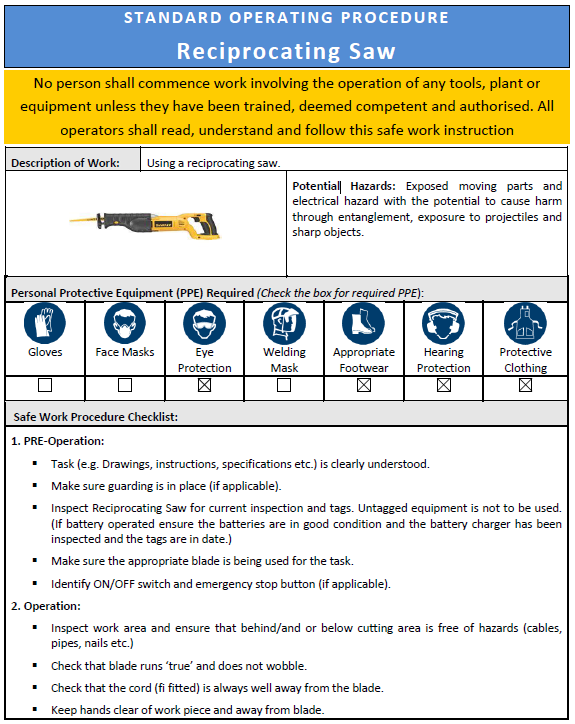
Reciprocating Saw: text version
No person shall commence work involving the operation of any tools, plant or equipment unless they have been trained, deemed competent and authorised. All operators shall read, understand and follow this safe work instruction
- Description of work
- Using a reciprocating saw.
- Potential hazards
- Exposed moving parts and electrical hazard with the potential to cause harm through entanglement, exposure to projectiles and sharp objects.
- PPE required
- Eye Protection, Appropriate Footwear, Hearing Protection, Protective Clothing
1. PRE-Operation:
- Task (e.g. Drawings, instructions, specifications etc.) is clearly understood.
- Make sure guarding is in place (if applicable).
- Inspect Reciprocating Saw for current inspection and tags. Untagged equipment is not to be used. (If battery operated ensure the batteries are in good condition and the battery charger has been inspected and the tags are in date.)
- Make sure the appropriate blade is being used for the task.
- Identify ON/OFF switch and emergency stop button (if applicable).
2. Operation:
- Inspect work area and ensure that behind/and or below cutting area is free of hazards (cables, pipes, nails etc.)
- Check that blade runs 'true' and does not wobble.
- Check that the cord (fi fitted) is always well away from the blade.
- Keep hands clear of work piece and away from blade.
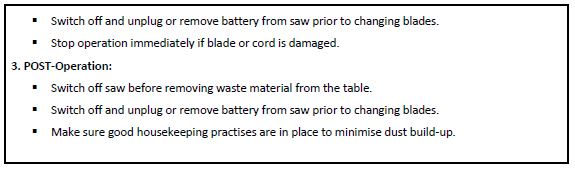
- Switch off and unplug or remove battery from saw prior to changing blades.
- Stop operation immediately if blade or cord is damaged.
3. POST-Operation:
- Switch off saw before removing waste material from the table.
- Switch off and unplug or remove battery from saw prior to changing blades.
- Make sure good housekeeping practises are in place to minimise dust build-up.
Transcribed from the scanned procedure. If the text and the scan differ, the scanned procedure applies.