

Standard operating procedure
Magnetic Drill
Read this procedure as text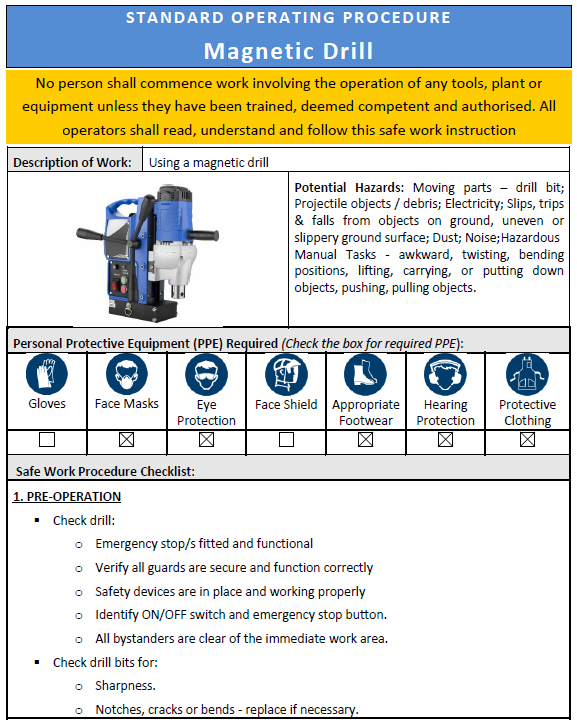
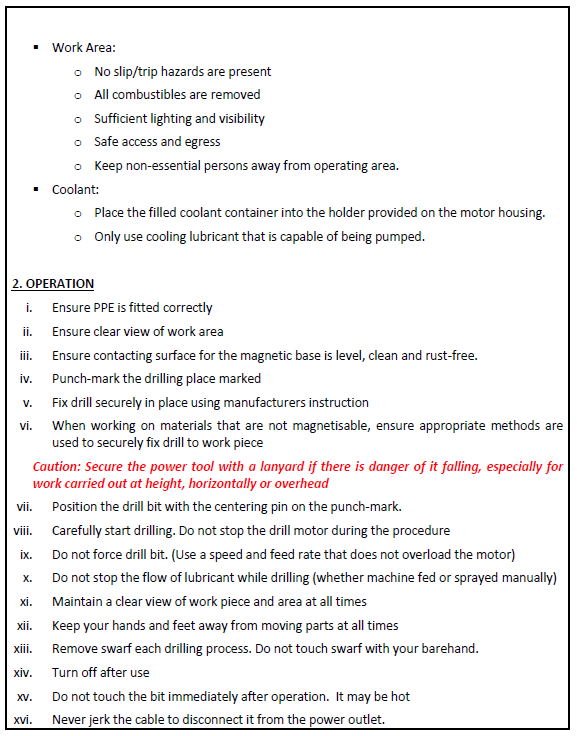
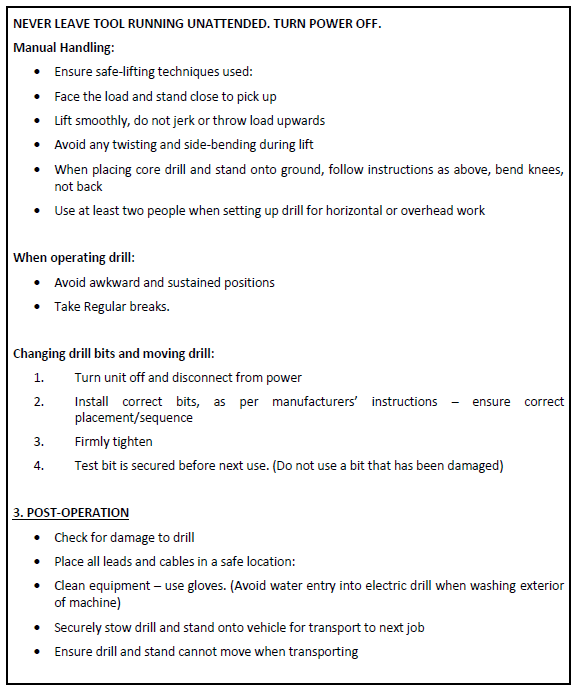
Magnetic Drill: text version
No person shall commence work involving the operation of any tools, plant or equipment unless they have been trained, deemed competent and authorised. All operators shall read, understand and follow this safe work instruction
- Description of work
- Using a magnetic drill
- Potential hazards
- Moving parts - drill bit; Projectile objects / debris; Electricity; Slips, trips & falls from objects on ground, uneven or slippery ground surface; Dust; Noise;Hazardous Manual Tasks - awkward, twisting, bending positions, lifting, carrying, or putting down objects, pushing, pulling objects.
- PPE required
- Face Masks, Eye Protection, Appropriate Footwear, Hearing Protection, Protective Clothing
1. PRE-OPERATION
- Check drill:
- Emergency stop/s fitted and functional
- Verify all guards are secure and function correctly
- Safety devices are in place and working properly
- Identify ON/OFF switch and emergency stop button.
- All bystanders are clear of the immediate work area.
- Check drill bits for:
- Sharpness.
- Notches, cracks or bends - replace if necessary.
- Work Area:
- No slip/trip hazards are present
- All combustibles are removed
- Sufficient lighting and visibility
- Safe access and egress
- Keep non-essential persons away from operating area.
- Coolant:
- Place the filled coolant container into the holder provided on the motor housing.
- Only use cooling lubricant that is capable of being pumped.
2. OPERATION
- Ensure PPE is fitted correctly
- Ensure clear view of work area
- Ensure contacting surface for the magnetic base is level, clean and rust-free.
- Punch-mark the drilling place marked
- Fix drill securely in place using manufacturers instruction
- When working on materials that are not magnetisable, ensure appropriate methods are used to securely fix drill to work piece
- Caution: Secure the power tool with a lanyard if there is danger of it falling, especially for work carried out at height, horizontally or overhead
- Position the drill bit with the centering pin on the punch-mark.
- Carefully start drilling. Do not stop the drill motor during the procedure
- Do not force drill bit. (Use a speed and feed rate that does not overload the motor)
- Do not stop the flow of lubricant while drilling (whether machine fed or sprayed manually)
- Maintain a clear view of work piece and area at all times
- Keep your hands and feet away from moving parts at all times
- Remove swarf each drilling process. Do not touch swarf with your barehand.
- Turn off after use
- Do not touch the bit immediately after operation. It may be hot
- Never jerk the cable to disconnect it from the power outlet.
- NEVER LEAVE TOOL RUNNING UNATTENDED. TURN POWER OFF.
Manual Handling:
- Ensure safe-lifting techniques used:
- Face the load and stand close to pick up
- Lift smoothly, do not jerk or throw load upwards
- Avoid any twisting and side-bending during lift
- When placing core drill and stand onto ground, follow instructions as above, bend knees, not back
- Use at least two people when setting up drill for horizontal or overhead work
When operating drill:
- Avoid awkward and sustained positions
- Take Regular breaks.
Changing drill bits and moving drill:
- Turn unit off and disconnect from power
- Install correct bits, as per manufacturers' instructions - ensure correct placement/sequence
- Firmly tighten
- Test bit is secured before next use. (Do not use a bit that has been damaged)
3. POST-OPERATION
- Check for damage to drill
- Place all leads and cables in a safe location:
- Clean equipment - use gloves. (Avoid water entry into electric drill when washing exterior of machine)
- Securely stow drill and stand onto vehicle for transport to next job
- Ensure drill and stand cannot move when transporting
Transcribed from the scanned procedure. If the text and the scan differ, the scanned procedure applies.