

Standard operating procedure
Lifting and Rigging
Read this procedure as text
Lifting and Rigging: text version
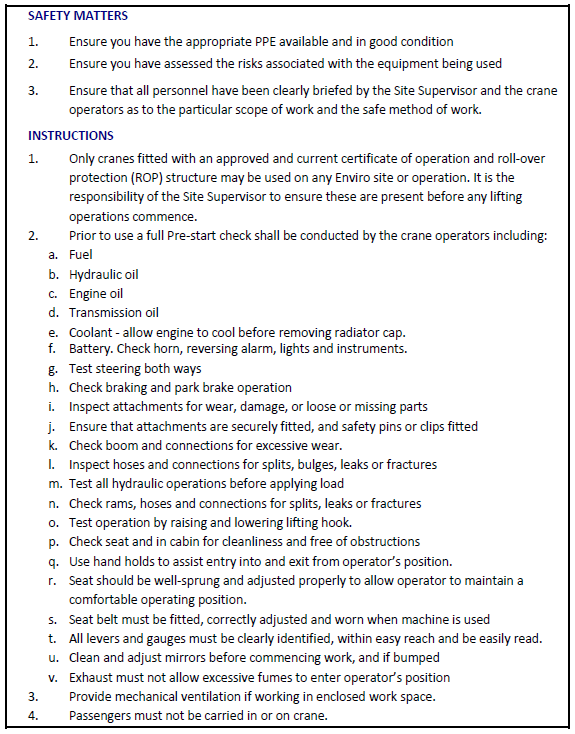
No person shall commence work involving the operation of any vehicle or mobile plant unless they are licensed, trained, deemed competent, are authorised and have read and follow this safe work procedure. No persons other than qualified rigger/dogmen are to assist in the rigging or directing of loads from a crane or other lifting apparatus.
- Description of work
- Lifting and rigging loads using a crane or other mobile lifting device.
- Potential hazards
- Manual Handling injuries; Slips, trips and falls; interaction with pedestrians; interaction with other plant; unlicensed operation; noise, dust, vibration; Falling objects; Suspended Loads
- PPE required
- Eye Protection, Hard Hat, Appropriate Footwear, Hearing Protection, Protective Clothing
SPECIAL INSTRUCTIONS
- A person must not operate within the working area of a crane unless they hold the appropriate Certificate of Competency or are being trained by a certificated person and have read and understood this standard operating procedure.
- Unregistered machinery and equipment must not be driven on a public roadway unless a permit to do so has been obtained from the relevant Traffic Authority.
- Check with relevant authority to ensure that services, cables, etc., will not be damaged during lifting operations.
- Barricades or rails shall be provided around the work area to ensure that unauthorised access cannot occur while machine is being operated.
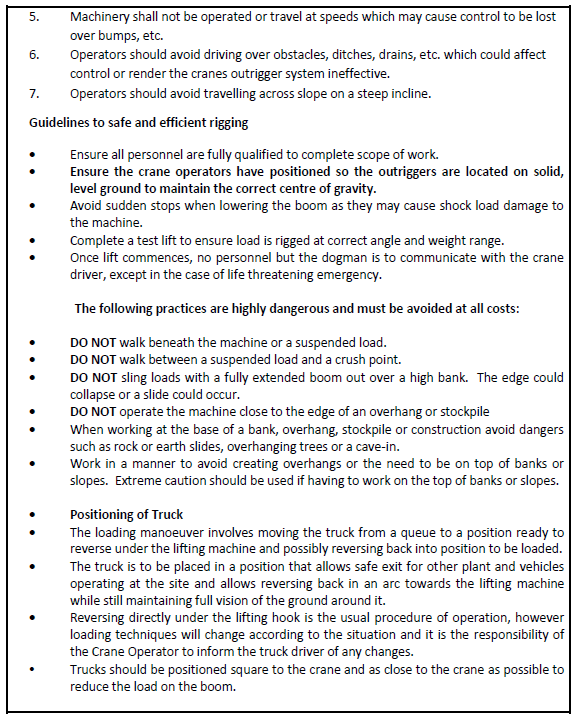
SAFETY MATTERS
- Ensure you have the appropriate PPE available and in good condition
- Ensure you have assessed the risks associated with the equipment being used
- Ensure that all personnel have been clearly briefed by the Site Supervisor and the crane operators as to the particular scope of work and the safe method of work.
INSTRUCTIONS
- Only cranes fitted with an approved and current certificate of operation and roll-over protection (ROP) structure may be used on any Enviro site or operation. It is the responsibility of the Site Supervisor to ensure these are present before any lifting operations commence.
- Prior to use a full Pre-start check shall be conducted by the crane operators including:
- Fuel
- Hydraulic oil
- Engine oil
- Transmission oil
- Coolant - allow engine to cool before removing radiator cap.
- Battery. Check horn, reversing alarm, lights and instruments.
- Test steering both ways
- Check braking and park brake operation
- Inspect attachments for wear, damage, or loose or missing parts
- Ensure that attachments are securely fitted, and safety pins or clips fitted
- Check boom and connections for excessive wear.
- Inspect hoses and connections for splits, bulges, leaks or fractures
- Test all hydraulic operations before applying load
- Check rams, hoses and connections for splits, leaks or fractures
- Test operation by raising and lowering lifting hook.
- Check seat and in cabin for cleanliness and free of obstructions
- Use hand holds to assist entry into and exit from operator's position.
- Seat should be well-sprung and adjusted properly to allow operator to maintain a comfortable operating position.
- Seat belt must be fitted, correctly adjusted and worn when machine is used
- All levers and gauges must be clearly identified, within easy reach and be easily read.
- Clean and adjust mirrors before commencing work, and if bumped
- Exhaust must not allow excessive fumes to enter operator's position
- Provide mechanical ventilation if working in enclosed work space.
- Passengers must not be carried in or on crane.
- Machinery shall not be operated or travel at speeds which may cause control to be lost over bumps, etc.
- Operators should avoid driving over obstacles, ditches, drains, etc. which could affect control or render the cranes outrigger system ineffective.
- Operators should avoid travelling across slope on a steep incline.
Guidelines to safe and efficient rigging
- Ensure all personnel are fully qualified to complete scope of work.
- Ensure the crane operators have positioned so the outriggers are located on solid, level ground to maintain the correct centre of gravity.
- Avoid sudden stops when lowering the boom as they may cause shock load damage to the machine.
- Complete a test lift to ensure load is rigged at correct angle and weight range.
- Once lift commences, no personnel but the dogman is to communicate with the crane driver, except in the case of life threatening emergency.
The following practices are highly dangerous and must be avoided at all costs:
- DO NOT walk beneath the machine or a suspended load.
- DO NOT walk between a suspended load and a crush point.
- DO NOT sling loads with a fully extended boom out over a high bank. The edge could collapse or a slide could occur.
- DO NOT operate the machine close to the edge of an overhang or stockpile
- When working at the base of a bank, overhang, stockpile or construction avoid dangers such as rock or earth slides, overhanging trees or a cave-in.
- Work in a manner to avoid creating overhangs or the need to be on top of banks or slopes. Extreme caution should be used if having to work on the top of banks or slopes.
Positioning of Truck
- The loading manoeuver involves moving the truck from a queue to a position ready to reverse under the lifting machine and possibly reversing back into position to be loaded.
- The truck is to be placed in a position that allows safe exit for other plant and vehicles operating at the site and allows reversing back in an arc towards the lifting machine while still maintaining full vision of the ground around it.
- Reversing directly under the lifting hook is the usual procedure of operation, however loading techniques will change according to the situation and it is the responsibility of the Crane Operator to inform the truck driver of any changes.
- Trucks should be positioned square to the crane and as close to the crane as possible to reduce the load on the boom.
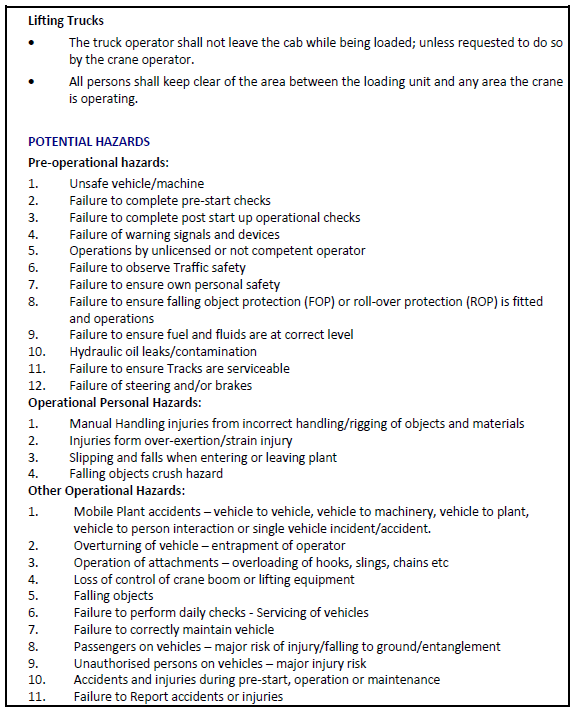
Lifting Trucks
- The truck operator shall not leave the cab while being loaded; unless requested to do so by the crane operator.
- All persons shall keep clear of the area between the loading unit and any area the crane is operating.
POTENTIAL HAZARDS
Pre-operational hazards:
- Unsafe vehicle/machine
- Failure to complete pre-start checks
- Failure to complete post start up operational checks
- Failure of warning signals and devices
- Operations by unlicensed or not competent operator
- Failure to observe Traffic safety
- Failure to ensure own personal safety
- Failure to ensure falling object protection (FOP) or roll-over protection (ROP) is fitted and operations
- Failure to ensure fuel and fluids are at correct level
- Hydraulic oil leaks/contamination
- Failure to ensure Tracks are serviceable
- Failure of steering and/or brakes
Operational Personal Hazards:
- Manual Handling injuries from incorrect handling/rigging of objects and materials
- Injuries form over-exertion/strain injury
- Slipping and falls when entering or leaving plant
- Falling objects crush hazard
Other Operational Hazards:
- Mobile Plant accidents - vehicle to vehicle, vehicle to machinery, vehicle to plant, vehicle to person interaction or single vehicle incident/accident.
- Overturning of vehicle - entrapment of operator
- Operation of attachments - overloading of hooks, slings, chains etc
- Loss of control of crane boom or lifting equipment
- Falling objects
- Failure to perform daily checks - Servicing of vehicles
- Failure to correctly maintain vehicle
- Passengers on vehicles - major risk of injury/falling to ground/entanglement
- Unauthorised persons on vehicles - major injury risk
- Accidents and injuries during pre-start, operation or maintenance
- Failure to Report accidents or injuries
Transcribed from the scanned procedure. If the text and the scan differ, the scanned procedure applies.