

Standard operating procedure
Hand-tools
Read this procedure as text
Hand-tools: text version
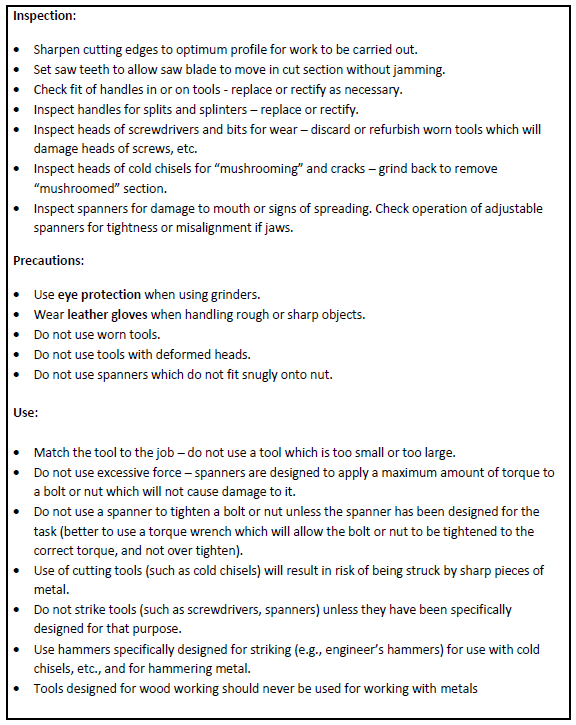
No person shall commence work involving the operation of any tools, plant or equipment unless they have been trained, deemed competent and authorised. All operators shall read, understand and follow this safe work instruction
- Description of work
- Using and caring for Hand tools
- Potential hazards
- Blunt cutting edges, worn working faces/edges, “mushroom” heads, deformed parts, tools slipping, damage to work, flying objects, damage & breakage, flying particles, incorrect fitting or loose handle.
- PPE required
- Eye Protection, Appropriate Footwear, Hearing Protection, Protective Clothing
SPECIAL INSTRUCTIONS:
- Keep hand tools in good condition and properly sharpened for safe and correct use. (Most accidents with hand tools occur because of poor maintenance or because the tool is blunt and excessive force is used due to tools not being able to carry out work).
- Hand tools should never be used for any purpose other than that for which they are designed.
- Provide suitable safe storage for hand tools, especially cutting tools such as chisels, etc.
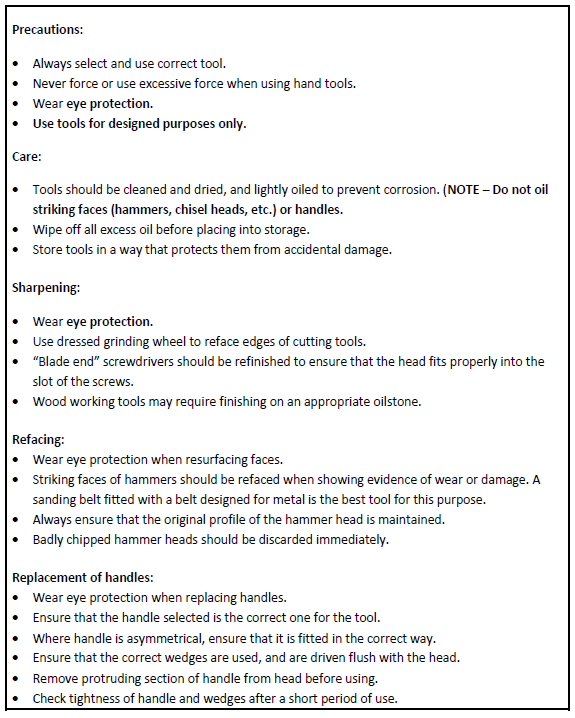
Inspection:
- Sharpen cutting edges to optimum profile for work to be carried out.
- Set saw teeth to allow saw blade to move in cut section without jamming.
- Check fit of handles in or on tools - replace or rectify as necessary.
- Inspect handles for splits and splinters - replace or rectify.
- Inspect heads of screwdrivers and bits for wear - discard or refurbish worn tools which will damage heads of screws, etc.
- Inspect heads of cold chisels for “mushrooming” and cracks - grind back to remove “mushroomed” section.
- Inspect spanners for damage to mouth or signs of spreading. Check operation of adjustable spanners for tightness or misalignment if jaws.
Precautions:
- Use eye protection when using grinders.
- Wear leather gloves when handling rough or sharp objects.
- Do not use worn tools.
- Do not use tools with deformed heads.
- Do not use spanners which do not fit snugly onto nut.
Use:
- Match the tool to the job - do not use a tool which is too small or too large.
- Do not use excessive force - spanners are designed to apply a maximum amount of torque to a bolt or nut which will not cause damage to it.
- Do not use a spanner to tighten a bolt or nut unless the spanner has been designed for the task (better to use a torque wrench which will allow the bolt or nut to be tightened to the correct torque, and not over tighten).
- Use of cutting tools (such as cold chisels) will result in risk of being struck by sharp pieces of metal.
- Do not strike tools (such as screwdrivers, spanners) unless they have been specifically designed for that purpose.
- Use hammers specifically designed for striking (e.g., engineer's hammers) for use with cold chisels, etc., and for hammering metal.
- Tools designed for wood working should never be used for working with metals
Precautions:
- Always select and use correct tool.
- Never force or use excessive force when using hand tools.
- Wear eye protection.
- Use tools for designed purposes only.
Care:
- Tools should be cleaned and dried, and lightly oiled to prevent corrosion. (NOTE - Do not oil striking faces (hammers, chisel heads, etc.) or handles.
- Wipe off all excess oil before placing into storage.
- Store tools in a way that protects them from accidental damage.
Sharpening:
- Wear eye protection.
- Use dressed grinding wheel to reface edges of cutting tools.
- “Blade end” screwdrivers should be refinished to ensure that the head fits properly into the slot of the screws.
- Wood working tools may require finishing on an appropriate oilstone.
Refacing:
- Wear eye protection when resurfacing faces.
- Striking faces of hammers should be refaced when showing evidence of wear or damage. A sanding belt fitted with a belt designed for metal is the best tool for this purpose.
- Always ensure that the original profile of the hammer head is maintained.
- Badly chipped hammer heads should be discarded immediately.
Replacement of handles:
- Wear eye protection when replacing handles.
- Ensure that the handle selected is the correct one for the tool.
- Where handle is asymmetrical, ensure that it is fitted in the correct way.
- Ensure that the correct wedges are used, and are driven flush with the head.
- Remove protruding section of handle from head before using.
- Check tightness of handle and wedges after a short period of use.
Transcribed from the scanned procedure. If the text and the scan differ, the scanned procedure applies.