

Standard operating procedure
Forklift
Read this procedure as text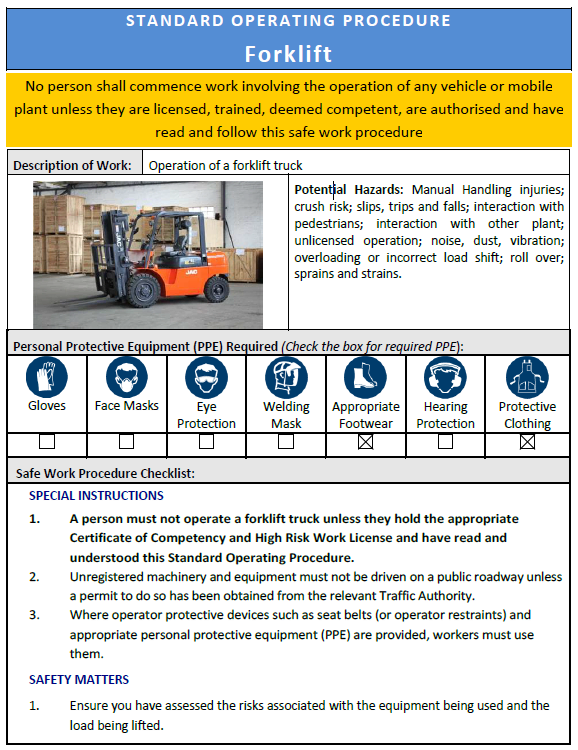
Forklift: text version
No person shall commence work involving the operation of any vehicle or mobile plant unless they are licensed, trained, deemed competent, are authorised and have read and follow this safe work procedure
- Description of work
- Operation of a forklift truck
- Potential hazards
- Manual Handling injuries; crush risk; slips, trips and falls; interaction with pedestrians; interaction with other plant; unlicensed operation; noise, dust, vibration; overloading or incorrect load shift; roll over; sprains and strains.
- PPE required
- Appropriate Footwear, Protective Clothing
SPECIAL INSTRUCTIONS
- A person must not operate a forklift truck unless they hold the appropriate Certificate of Competency and High Risk Work License and have read and understood this Standard Operating Procedure.
- Unregistered machinery and equipment must not be driven on a public roadway unless a permit to do so has been obtained from the relevant Traffic Authority.
- Where operator protective devices such as seat belts (or operator restraints) and appropriate personal protective equipment (PPE) are provided, workers must use them.
SAFETY MATTERS
- Ensure you have assessed the risks associated with the equipment being used and the load being lifted.
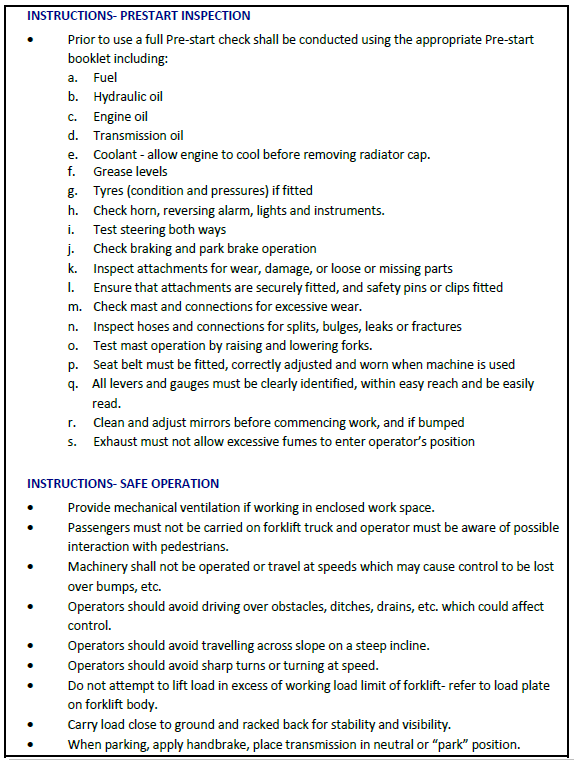
INSTRUCTIONS- PRESTART INSPECTION
- Prior to use a full Pre-start check shall be conducted using the appropriate Pre-start booklet including:
- Fuel
- Hydraulic oil
- Engine oil
- Transmission oil
- Coolant - allow engine to cool before removing radiator cap.
- Grease levels
- Tyres (condition and pressures) if fitted
- Check horn, reversing alarm, lights and instruments.
- Test steering both ways
- Check braking and park brake operation
- Inspect attachments for wear, damage, or loose or missing parts
- Ensure that attachments are securely fitted, and safety pins or clips fitted
- Check mast and connections for excessive wear.
- Inspect hoses and connections for splits, bulges, leaks or fractures
- Test mast operation by raising and lowering forks.
- Seat belt must be fitted, correctly adjusted and worn when machine is used
- All levers and gauges must be clearly identified, within easy reach and be easily read.
- Clean and adjust mirrors before commencing work, and if bumped
- Exhaust must not allow excessive fumes to enter operator's position
INSTRUCTIONS- SAFE OPERATION
- Provide mechanical ventilation if working in enclosed work space.
- Passengers must not be carried on forklift truck and operator must be aware of possible interaction with pedestrians.
- Machinery shall not be operated or travel at speeds which may cause control to be lost over bumps, etc.
- Operators should avoid driving over obstacles, ditches, drains, etc. which could affect control.
- Operators should avoid travelling across slope on a steep incline.
- Operators should avoid sharp turns or turning at speed.
- Do not attempt to lift load in excess of working load limit of forklift- refer to load plate on forklift body.
- Carry load close to ground and racked back for stability and visibility.
- When parking, apply handbrake, place transmission in neutral or "park" position.
- When approaching a blind corner, use horn and reduce speed.
- If vision restricted due to load, request spotter to guide forklift movements.
- When travelling with a raised mast or load, always visually inspect for overhead obstructions.
- If a load is located beyond the safe reach of the forklift tines, the operator is to utilise the rated forklift tine extensions, located in the yard.
- In instances whereby the operator has obscured vision or is unsure of the location of pedestrians, the operator should sound the horn when approaching and/or entering a building or area to alert nearby personnel.
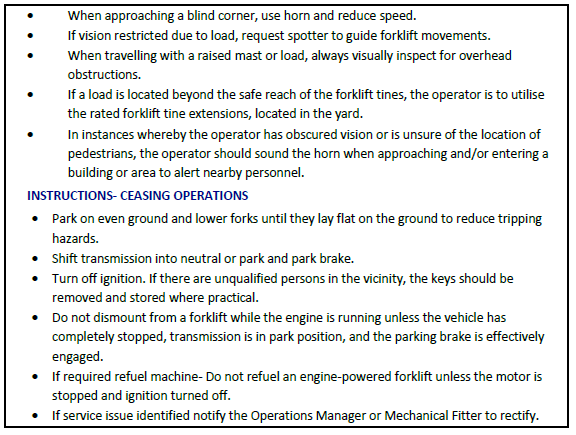
INSTRUCTIONS- CEASING OPERATIONS
- Park on even ground and lower forks until they lay flat on the ground to reduce tripping hazards.
- Shift transmission into neutral or park and park brake.
- Turn off ignition. If there are unqualified persons in the vicinity, the keys should be removed and stored where practical.
- Do not dismount from a forklift while the engine is running unless the vehicle has completely stopped, transmission is in park position, and the parking brake is effectively engaged.
- If required refuel machine- Do not refuel an engine-powered forklift unless the motor is stopped and ignition turned off.
- If service issue identified notify the Operations Manager or Mechanical Fitter to rectify.
Transcribed from the scanned procedure. If the text and the scan differ, the scanned procedure applies.