

Standard operating procedure
Excavator
Read this procedure as text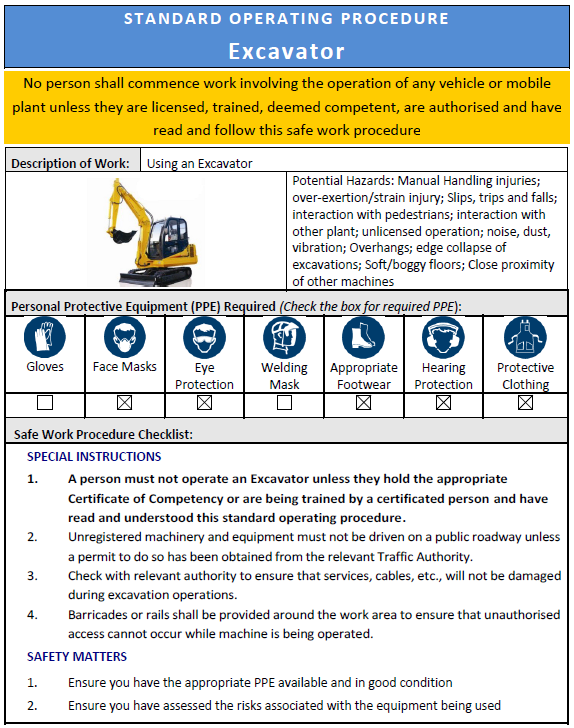
Excavator: text version
No person shall commence work involving the operation of any vehicle or mobile plant unless they are licensed, trained, deemed competent, are authorised and have read and follow this safe work procedure
- Description of work
- Using an Excavator
- Potential hazards
- Manual Handling injuries; over-exertion/strain injury; Slips, trips and falls; interaction with pedestrians; interaction with other plant; unlicensed operation; noise, dust, vibration; Overhangs; edge collapse of excavations; Soft/boggy floors; Close proximity of other machines
- PPE required
- Face Masks, Eye Protection, Appropriate Footwear, Hearing Protection, Protective Clothing
SPECIAL INSTRUCTIONS
- A person must not operate an Excavator unless they hold the appropriate Certificate of Competency or are being trained by a certificated person and have read and understood this standard operating procedure.
- Unregistered machinery and equipment must not be driven on a public roadway unless a permit to do so has been obtained from the relevant Traffic Authority.
- Check with relevant authority to ensure that services, cables, etc., will not be damaged during excavation operations.
- Barricades or rails shall be provided around the work area to ensure that unauthorised access cannot occur while machine is being operated.
SAFETY MATTERS
- Ensure you have the appropriate PPE available and in good condition
- Ensure you have assessed the risks associated with the equipment being used
INSTRUCTIONS
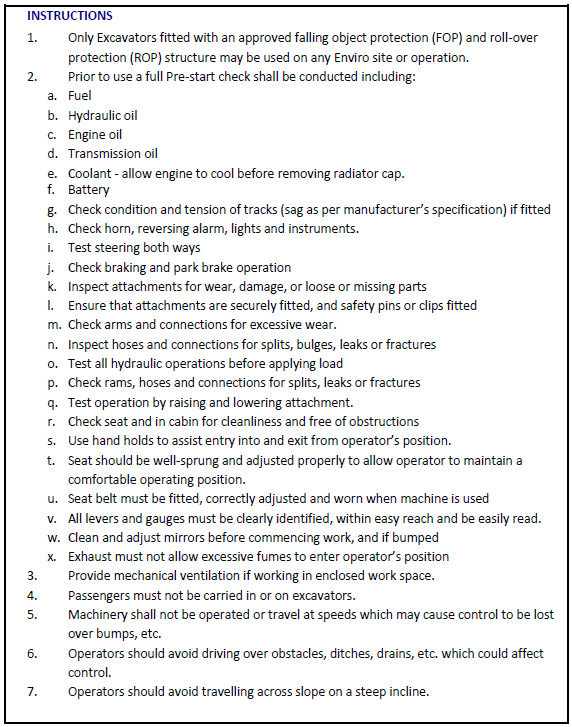
- Only Excavators fitted with an approved falling object protection (FOP) and roll-over protection (ROP) structure may be used on any Enviro site or operation.
- Prior to use a full Pre-start check shall be conducted including:
- Fuel
- Hydraulic oil
- Engine oil
- Transmission oil
- Coolant - allow engine to cool before removing radiator cap.
- Battery
- Check condition and tension of tracks (sag as per manufacturer's specification) if fitted
- Check horn, reversing alarm, lights and instruments.
- Test steering both ways
- Check braking and park brake operation
- Inspect attachments for wear, damage, or loose or missing parts
- Ensure that attachments are securely fitted, and safety pins or clips fitted
- Check arms and connections for excessive wear.
- Inspect hoses and connections for splits, bulges, leaks or fractures
- Test all hydraulic operations before applying load
- Check rams, hoses and connections for splits, leaks or fractures
- Test operation by raising and lowering attachment.
- Check seat and in cabin for cleanliness and free of obstructions
- Use hand holds to assist entry into and exit from operator's position.
- Seat should be well-sprung and adjusted properly to allow operator to maintain a comfortable operating position.
- Seat belt must be fitted, correctly adjusted and worn when machine is used
- All levers and gauges must be clearly identified, within easy reach and be easily read.
- Clean and adjust mirrors before commencing work, and if bumped
- Exhaust must not allow excessive fumes to enter operator's position
- Provide mechanical ventilation if working in enclosed work space.
- Passengers must not be carried in or on excavators.
- Machinery shall not be operated or travel at speeds which may cause control to be lost over bumps, etc.
- Operators should avoid driving over obstacles, ditches, drains, etc. which could affect control.
- Operators should avoid travelling across slope on a steep incline.
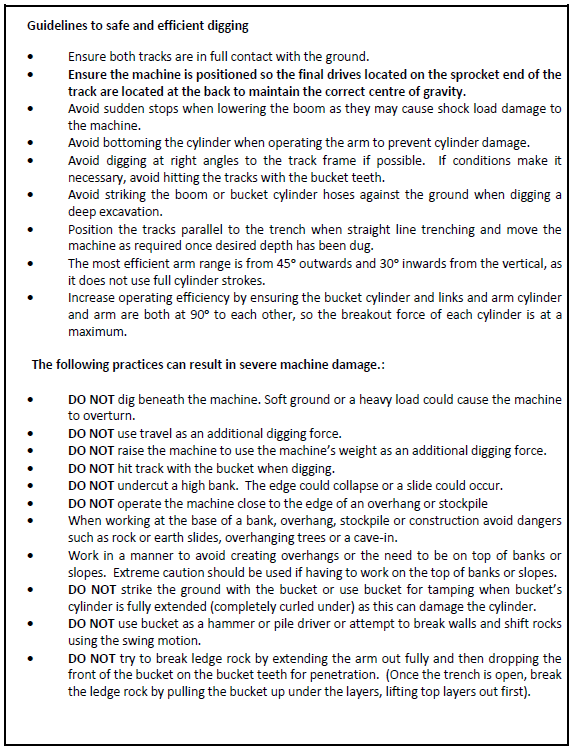
Guidelines to safe and efficient digging
- Ensure both tracks are in full contact with the ground.
- Ensure the machine is positioned so the final drives located on the sprocket end of the track are located at the back to maintain the correct centre of gravity.
- Avoid sudden stops when lowering the boom as they may cause shock load damage to the machine.
- Avoid bottoming the cylinder when operating the arm to prevent cylinder damage.
- Avoid digging at right angles to the track frame if possible. If conditions make it necessary, avoid hitting the tracks with the bucket teeth.
- Avoid striking the boom or bucket cylinder hoses against the ground when digging a deep excavation.
- Position the tracks parallel to the trench when straight line trenching and move the machine as required once desired depth has been dug.
- The most efficient arm range is from 45° outwards and 30° inwards from the vertical, as it does not use full cylinder strokes.
- Increase operating efficiency by ensuring the bucket cylinder and links and arm cylinder and arm are both at 90° to each other, so the breakout force of each cylinder is at a maximum.
The following practices can result in severe machine damage.:
- DO NOT dig beneath the machine. Soft ground or a heavy load could cause the machine to overturn.
- DO NOT use travel as an additional digging force.
- DO NOT raise the machine to use the machine's weight as an additional digging force.
- DO NOT hit track with the bucket when digging.
- DO NOT undercut a high bank. The edge could collapse or a slide could occur.
- DO NOT operate the machine close to the edge of an overhang or stockpile
- When working at the base of a bank, overhang, stockpile or construction avoid dangers such as rock or earth slides, overhanging trees or a cave-in.
- Work in a manner to avoid creating overhangs or the need to be on top of banks or slopes. Extreme caution should be used if having to work on the top of banks or slopes.
- DO NOT strike the ground with the bucket or use bucket for tamping when bucket's cylinder is fully extended (completely curled under) as this can damage the cylinder.
- DO NOT use bucket as a hammer or pile driver or attempt to break walls and shift rocks using the swing motion.
- DO NOT try to break ledge rock by extending the arm out fully and then dropping the front of the bucket on the bucket teeth for penetration. (Once the trench is open, break the ledge rock by pulling the bucket up under the layers, lifting top layers out first).
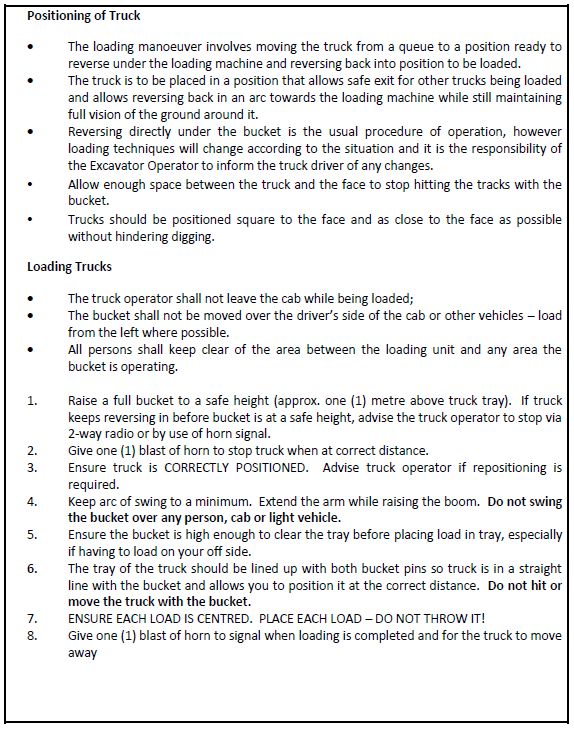
Positioning of Truck
- The loading manoeuver involves moving the truck from a queue to a position ready to reverse under the loading machine and reversing back into position to be loaded.
- The truck is to be placed in a position that allows safe exit for other trucks being loaded and allows reversing back in an arc towards the loading machine while still maintaining full vision of the ground around it.
- Reversing directly under the bucket is the usual procedure of operation, however loading techniques will change according to the situation and it is the responsibility of the Excavator Operator to inform the truck driver of any changes.
- Allow enough space between the truck and the face to stop hitting the tracks with the bucket.
- Trucks should be positioned square to the face and as close to the face as possible without hindering digging.
Loading Trucks
- The truck operator shall not leave the cab while being loaded;
- The bucket shall not be moved over the driver's side of the cab or other vehicles - load from the left where possible.
- All persons shall keep clear of the area between the loading unit and any area the bucket is operating.
- Raise a full bucket to a safe height (approx. one (1) metre above truck tray). If truck keeps reversing in before bucket is at a safe height, advise the truck operator to stop via 2-way radio or by use of horn signal.
- Give one (1) blast of horn to stop truck when at correct distance.
- Ensure truck is CORRECTLY POSITIONED. Advise truck operator if repositioning is required.
- Keep arc of swing to a minimum. Extend the arm while raising the boom. Do not swing the bucket over any person, cab or light vehicle.
- Ensure the bucket is high enough to clear the tray before placing load in tray, especially if having to load on your off side.
- The tray of the truck should be lined up with both bucket pins so truck is in a straight line with the bucket and allows you to position it at the correct distance. Do not hit or move the truck with the bucket.
- ENSURE EACH LOAD IS CENTRED. PLACE EACH LOAD - DO NOT THROW IT!
- Give one (1) blast of horn to signal when loading is completed and for the truck to move away
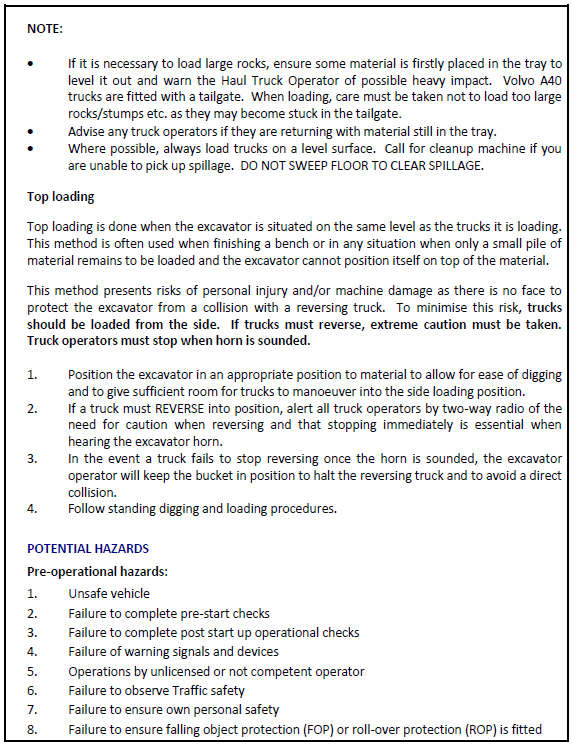
NOTE:
- If it is necessary to load large rocks, ensure some material is firstly placed in the tray to level it out and warn the Haul Truck Operator of possible heavy impact. Volvo A40 trucks are fitted with a tailgate. When loading, care must be taken not to load too large rocks/stumps etc. as they may become stuck in the tailgate.
- Advise any truck operators if they are returning with material still in the tray.
- Where possible, always load trucks on a level surface. Call for cleanup machine if you are unable to pick up spillage. DO NOT SWEEP FLOOR TO CLEAR SPILLAGE.
Top loading
- Top loading is done when the excavator is situated on the same level as the trucks it is loading. This method is often used when finishing a bench or in any situation when only a small pile of material remains to be loaded and the excavator cannot position itself on top of the material.
- This method presents risks of personal injury and/or machine damage as there is no face to protect the excavator from a collision with a reversing truck. To minimise this risk, trucks should be loaded from the side. If trucks must reverse, extreme caution must be taken. Truck operators must stop when horn is sounded.
- Position the excavator in an appropriate position to material to allow for ease of digging and to give sufficient room for trucks to manoeuver into the side loading position.
- If a truck must REVERSE into position, alert all truck operators by two-way radio of the need for caution when reversing and that stopping immediately is essential when hearing the excavator horn.
- In the event a truck fails to stop reversing once the horn is sounded, the excavator operator will keep the bucket in position to halt the reversing truck and to avoid a direct collision.
- Follow standing digging and loading procedures.
POTENTIAL HAZARDS - Pre-operational hazards:
- Unsafe vehicle
- Failure to complete pre-start checks
- Failure to complete post start up operational checks
- Failure of warning signals and devices
- Operations by unlicensed or not competent operator
- Failure to observe Traffic safety
- Failure to ensure own personal safety
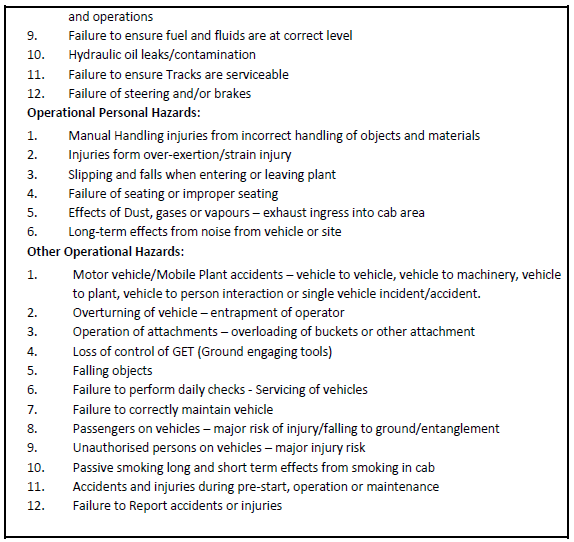
- Failure to ensure falling object protection (FOP) or roll-over protection (ROP) is fitted and operations
- Failure to ensure fuel and fluids are at correct level
- Hydraulic oil leaks/contamination
- Failure to ensure Tracks are serviceable
- Failure of steering and/or brakes
Operational Personal Hazards:
- Manual Handling injuries from incorrect handling of objects and materials
- Injuries form over-exertion/strain injury
- Slipping and falls when entering or leaving plant
- Failure of seating or improper seating
- Effects of Dust, gases or vapours - exhaust ingress into cab area
- Long-term effects from noise from vehicle or site
Other Operational Hazards:
- Motor vehicle/Mobile Plant accidents - vehicle to vehicle, vehicle to machinery, vehicle to plant, vehicle to person interaction or single vehicle incident/accident.
- Overturning of vehicle - entrapment of operator
- Operation of attachments - overloading of buckets or other attachment
- Loss of control of GET (Ground engaging tools)
- Falling objects
- Failure to perform daily checks - Servicing of vehicles
- Failure to correctly maintain vehicle
- Passengers on vehicles - major risk of injury/falling to ground/entanglement
- Unauthorised persons on vehicles - major injury risk
- Passive smoking long and short term effects from smoking in cab
- Accidents and injuries during pre-start, operation or maintenance
- Failure to Report accidents or injuries
Transcribed from the scanned procedure. If the text and the scan differ, the scanned procedure applies.