

Standard operating procedure
Dewatering Pump
Read this procedure as text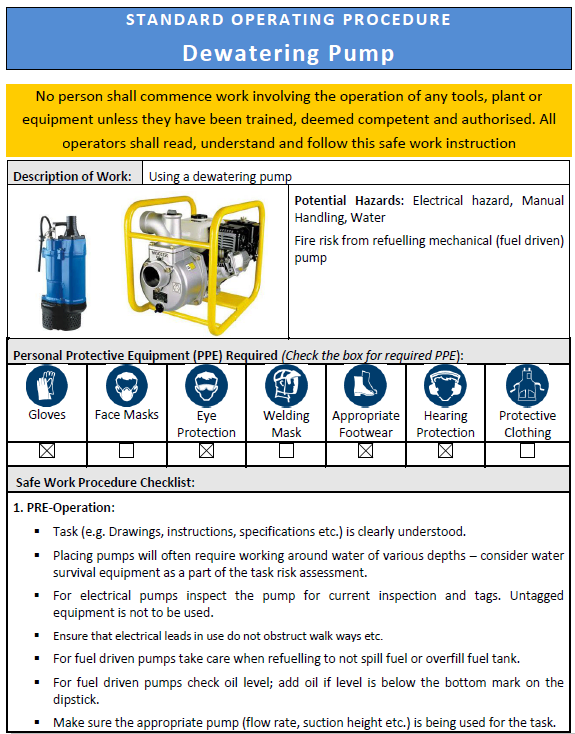
Dewatering Pump: text version
No person shall commence work involving the operation of any tools, plant or equipment unless they have been trained, deemed competent and authorised. All operators shall read, understand and follow this safe work instruction
- Description of work
- Using a dewatering pump
- Potential hazards
- Electrical hazard, Manual Handling, Water Fire risk from refuelling mechanical (fuel driven) pump
- PPE required
- Gloves, Eye Protection, Appropriate Footwear, Hearing Protection
1. PRE-Operation:
- Task (e.g. Drawings, instructions, specifications etc.) is clearly understood.
- Placing pumps will often require working around water of various depths - consider water survival equipment as a part of the task risk assessment.
- For electrical pumps inspect the pump for current inspection and tags. Untagged equipment is not to be used.
- Ensure that electrical leads in use do not obstruct walk ways etc.
- For fuel driven pumps take care when refuelling to not spill fuel or overfill fuel tank.
- For fuel driven pumps check oil level; add oil if level is below the bottom mark on the dipstick.
- Make sure the appropriate pump (flow rate, suction height etc.) is being used for the task.
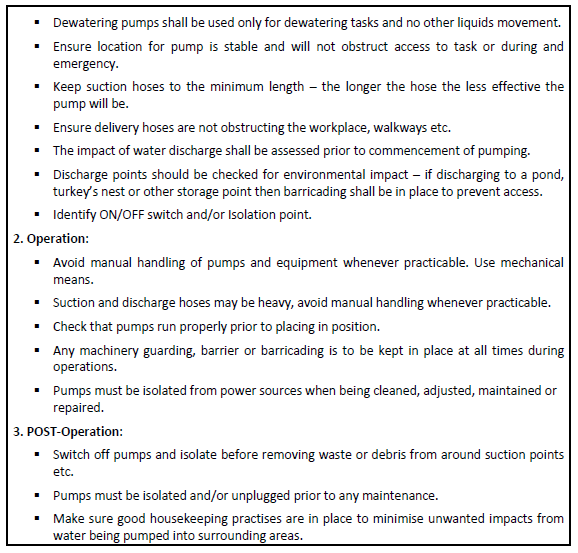
- Dewatering pumps shall be used only for dewatering tasks and no other liquids movement.
- Ensure location for pump is stable and will not obstruct access to task or during and emergency.
- Keep suction hoses to the minimum length - the longer the hose the less effective the pump will be.
- Ensure delivery hoses are not obstructing the workplace, walkways etc.
- The impact of water discharge shall be assessed prior to commencement of pumping.
- Discharge points should be checked for environmental impact - if discharging to a pond, turkey's nest or other storage point then barricading shall be in place to prevent access.
- Identify ON/OFF switch and/or Isolation point.
2. Operation:
- Avoid manual handling of pumps and equipment whenever practicable. Use mechanical means.
- Suction and discharge hoses may be heavy, avoid manual handling whenever practicable.
- Check that pumps run properly prior to placing in position.
- Any machinery guarding, barrier or barricading is to be kept in place at all times during operations.
- Pumps must be isolated from power sources when being cleaned, adjusted, maintained or repaired.
3. POST-Operation:
- Switch off pumps and isolate before removing waste or debris from around suction points etc.
- Pumps must be isolated and/or unplugged prior to any maintenance.
- Make sure good housekeeping practises are in place to minimise unwanted impacts from water being pumped into surrounding areas.
Transcribed from the scanned procedure. If the text and the scan differ, the scanned procedure applies.