

Standard operating procedure
Blasting
Read this procedure as text
Blasting: text version
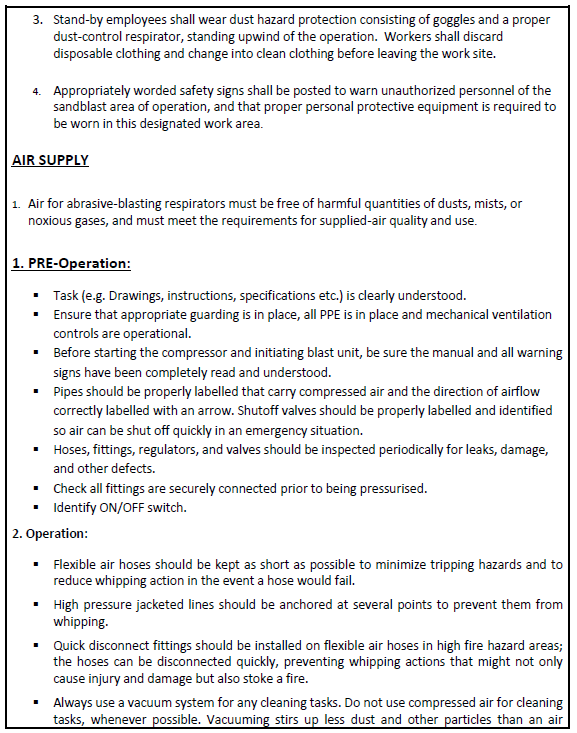
No person shall commence work involving the operation of any tools, plant or equipment unless they have been trained, deemed competent and authorised. All operators shall read, understand and follow this safe work instruction
- Description of work
- Using a compressed air blasting unit (Industrial quality)
- Potential hazards
- Electrical and compression hazard with the potential to cause harm through exposure to noise and compressed air; abrasion and injury due to interaction with blast garnet;
- PPE required
- Gloves, Face Masks, Eye Protection, Blasting Helmet, Appropriate Footwear, Hearing Protection, Protective Clothing
Compressed air operation rules
PPE
- Equipment for protection of the eyes and face shall be supplied to the operator when the respirator design does not provide such protection and to any other personnel working in the vicinity of abrasive blasting operations. This equipment shall conform to the Australian Standard.
- Appropriate personal protective equipment includes the use of a full sandblast outfit consisting of a rigid blasting helmet with air-flow control valves and filters approved for such use (example: Bullard supplied-air hood), disposable full-body protective clothing, steel-toed leather boots, and leather gloves.
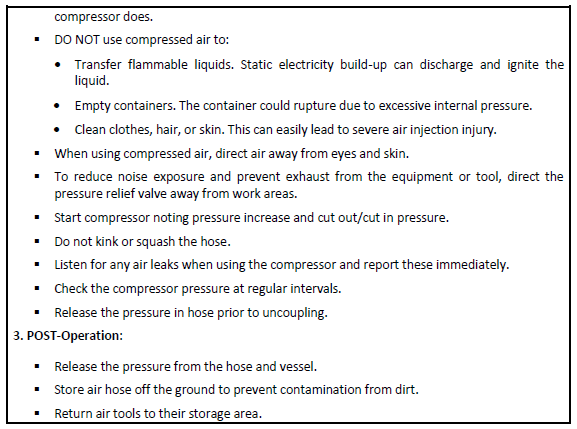
- Stand-by employees shall wear dust hazard protection consisting of goggles and a proper dust-control respirator, standing upwind of the operation. Workers shall discard disposable clothing and change into clean clothing before leaving the work site.
- Appropriately worded safety signs shall be posted to warn unauthorized personnel of the sandblast area of operation, and that proper personal protective equipment is required to be worn in this designated work area.
AIR SUPPLY
- Air for abrasive-blasting respirators must be free of harmful quantities of dusts, mists, or noxious gases, and must meet the requirements for supplied-air quality and use.
1. PRE-Operation:
- Task (e.g. Drawings, instructions, specifications etc.) is clearly understood.
- Ensure that appropriate guarding is in place, all PPE is in place and mechanical ventilation controls are operational.
- Before starting the compressor and initiating blast unit, be sure the manual and all warning signs have been completely read and understood.
- Pipes should be properly labelled that carry compressed air and the direction of airflow correctly labelled with an arrow. Shutoff valves should be properly labelled and identified so air can be shut off quickly in an emergency situation.
- Hoses, fittings, regulators, and valves should be inspected periodically for leaks, damage, and other defects.
- Check all fittings are securely connected prior to being pressurised.
- Identify ON/OFF switch.
2. Operation:
- Flexible air hoses should be kept as short as possible to minimize tripping hazards and to reduce whipping action in the event a hose would fail.
- High pressure jacketed lines should be anchored at several points to prevent them from whipping.
- Quick disconnect fittings should be installed on flexible air hoses in high fire hazard areas; the hoses can be disconnected quickly, preventing whipping actions that might not only cause injury and damage but also stoke a fire.
- Always use a vacuum system for any cleaning tasks. Do not use compressed air for cleaning tasks, whenever possible. Vacuuming stirs up less dust and other particles than an air compressor does.
- DO NOT use compressed air to:
- Transfer flammable liquids. Static electricity build-up can discharge and ignite the liquid.
- Empty containers. The container could rupture due to excessive internal pressure.
- Clean clothes, hair, or skin. This can easily lead to severe air injection injury.
- When using compressed air, direct air away from eyes and skin.
- To reduce noise exposure and prevent exhaust from the equipment or tool, direct the pressure relief valve away from work areas.
- Start compressor noting pressure increase and cut out/cut in pressure.
- Do not kink or squash the hose.
- Listen for any air leaks when using the compressor and report these immediately.
- Check the compressor pressure at regular intervals.
- Release the pressure in hose prior to uncoupling.
3. POST-Operation:
- Release the pressure from the hose and vessel.
- Store air hose off the ground to prevent contamination from dirt.
- Return air tools to their storage area.
Transcribed from the scanned procedure. If the text and the scan differ, the scanned procedure applies.