

Standard operating procedure
Air Powered Nail Gun
Read this procedure as text
Air Powered Nail Gun: text version
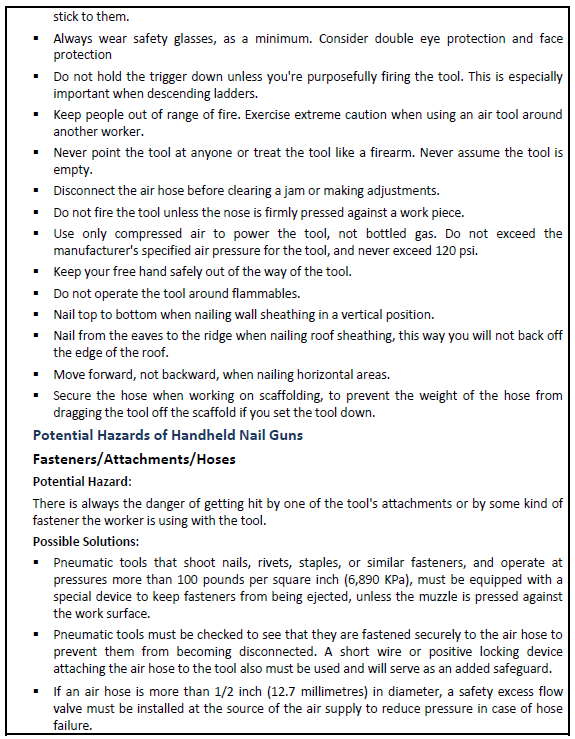
No person shall commence work involving the operation of any tools, plant or equipment unless they have been trained, deemed competent and authorised. All operators shall read, understand and follow this safe work instruction
- Description of work
- Using an Air Powered Nail Gun
- Potential hazards
- Noise; air under pressure; ricochet; flying projectiles; misuse; whipping hoses. Improper use of this equipment will lead to fatalities.
- PPE required
- Gloves, Eye Protection, Appropriate Footwear, Hearing Protection, Protective Clothing
1. PRE-Operation:
- Task (e.g. Drawings, instructions, specifications etc.) is clearly understood.
- Nail gun, air compressor/supply, hoses and all fittings is to be inspected prior to use. Damaged equipment shall not be used.
- Only the appropriate nails, timber and equipment are to be used.
- Signage is to be prominent around the work area.
- Barricading is in place and all other workers notified of operation of nail gun.
- A risk assessment has been conducted and nail gun use is authorised.
2. Operation:
- Do not attempt to use a nail gun unless you have first received instructions on safe use.
- Read printed instructions provided with the tool for its safe use. Remember the rules and stick to them.
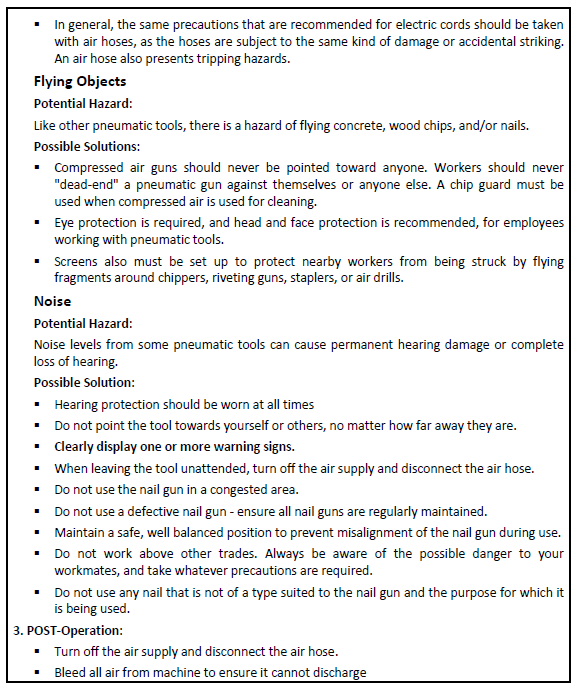
- Always wear safety glasses, as a minimum. Consider double eye protection and face protection
- Do not hold the trigger down unless you're purposefully firing the tool. This is especially important when descending ladders.
- Keep people out of range of fire. Exercise extreme caution when using an air tool around another worker.
- Never point the tool at anyone or treat the tool like a firearm. Never assume the tool is empty.
- Disconnect the air hose before clearing a jam or making adjustments.
- Do not fire the tool unless the nose is firmly pressed against a work piece.
- Use only compressed air to power the tool, not bottled gas. Do not exceed the manufacturer's specified air pressure for the tool, and never exceed 120 psi.
- Keep your free hand safely out of the way of the tool.
- Do not operate the tool around flammables.
- Nail top to bottom when nailing wall sheathing in a vertical position.
- Nail from the eaves to the ridge when nailing roof sheathing, this way you will not back off the edge of the roof.
- Move forward, not backward, when nailing horizontal areas.
- Secure the hose when working on scaffolding, to prevent the weight of the hose from dragging the tool off the scaffold if you set the tool down.
Potential Hazards of Handheld Nail Guns
Fasteners/Attachments/Hoses
- Potential Hazard:
- There is always the danger of getting hit by one of the tool's attachments or by some kind of fastener the worker is using with the tool.
- Possible Solutions:
- Pneumatic tools that shoot nails, rivets, staples, or similar fasteners, and operate at pressures more than 100 pounds per square inch (6,890 KPa), must be equipped with a special device to keep fasteners from being ejected, unless the muzzle is pressed against the work surface.
- Pneumatic tools must be checked to see that they are fastened securely to the air hose to prevent them from becoming disconnected. A short wire or positive locking device attaching the air hose to the tool also must be used and will serve as an added safeguard.
- If an air hose is more than 1/2 inch (12.7 millimetres) in diameter, a safety excess flow valve must be installed at the source of the air supply to reduce pressure in case of hose failure.
- In general, the same precautions that are recommended for electric cords should be taken with air hoses, as the hoses are subject to the same kind of damage or accidental striking. An air hose also presents tripping hazards.
Flying Objects
- Potential Hazard:
- Like other pneumatic tools, there is a hazard of flying concrete, wood chips, and/or nails.
- Possible Solutions:
- Compressed air guns should never be pointed toward anyone. Workers should never "dead-end" a pneumatic gun against themselves or anyone else. A chip guard must be used when compressed air is used for cleaning.
- Eye protection is required, and head and face protection is recommended, for employees working with pneumatic tools.
- Screens also must be set up to protect nearby workers from being struck by flying fragments around chippers, riveting guns, staplers, or air drills.
Noise
- Potential Hazard:
- Noise levels from some pneumatic tools can cause permanent hearing damage or complete loss of hearing.
- Possible Solution:
- Hearing protection should be worn at all times
- Do not point the tool towards yourself or others, no matter how far away they are.
- Clearly display one or more warning signs.
- When leaving the tool unattended, turn off the air supply and disconnect the air hose.
- Do not use the nail gun in a congested area.
- Do not use a defective nail gun - ensure all nail guns are regularly maintained.
- Maintain a safe, well balanced position to prevent misalignment of the nail gun during use.
- Do not work above other trades. Always be aware of the possible danger to your workmates, and take whatever precautions are required.
- Do not use any nail that is not of a type suited to the nail gun and the purpose for which it is being used.
3. POST-Operation:
- Turn off the air supply and disconnect the air hose.
- Bleed all air from machine to ensure it cannot discharge
Transcribed from the scanned procedure. If the text and the scan differ, the scanned procedure applies.